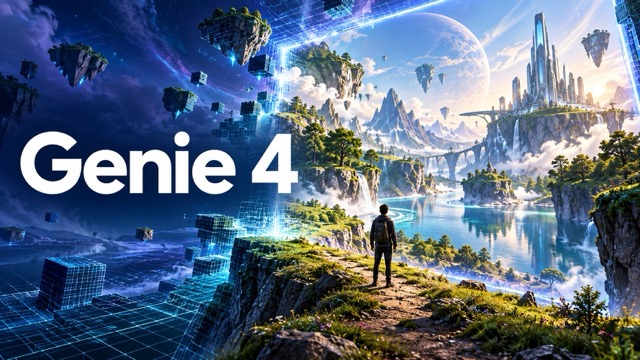
Genie 4 Explained: Inside Google's New Interactive AI World Model
Explore How Google's New World Model Turns Visual Ideas Into Interactive Environments. Understand the Roles of Real-Time Control, Native Audio, and Gemini Planning, Then Learn How World Simulation Differs From Video Generation and Where Its Research Preview Still Falls Short.
What Is Google DeepMind Genie 4?
Developed by Google's AI research organization, Google DeepMind, Genie 4 belongs to the AI world model category. In plain language, a world model predicts how an environment might evolve as events unfold or users act. Google's earlier Genie 3 research already explored generating navigable environments, establishing the background for this direction.
Think of a fictional seaside village. An image gives you one view; a conventional generated video gives you a sequence to watch; a chatbot can describe the village. An interactive environment lets you explore what comes next. These experiences can share prompts. An explorable-looking scene does not guarantee an accurate map.
How Does the Genie 4 World Model Work?
At the experience level, the process is a feedback loop: describe a setting, observe it, provide an action or instruction, and see the continuation. Google's official demonstrations include text-directed scenes and examples using reference images as visual starting points. The company describes keyboard navigation and text prompts that steer the simulation.
This explains how Genie 4 works from a user's perspective, rather than providing an architectural specification. A useful analogy is improvisation: each new instruction changes the next part of the performance. The model must make that continuation fit the scene already established. Looking convincing in the moment and preserving every detail throughout an extended session are separate challenges.
Key Features of Google Genie 4
1. Real-Time World Exploration and Control
Google describes natural-language changes such as moving the camera, changing weather, and adding characters. The creative value is iteration during an experience. For an imagined village scene, a creator might request rain and then explore another angle, using the response to refine an idea. This example illustrates the workflow; it is not a claim that every instruction succeeds consistently.
2. More Realistic Motion and Physical Interactions
Google reports improvements in human movement and simulated interactions, including collisions and aerodynamics. For viewers, believable motion can make a setting feel inhabited. However, a convincing collision should not be treated as a measured physics calculation. Visual plausibility helps storytelling, while engineering decisions require evidence about accuracy, repeatability, and behavior outside selected demonstrations.
3. Native Audio and Interactive Dialogue
Google's launch summary confirms generated ambient sound, music, and interactive dialogue. Audio adds another dimension to exploration: a scene can respond through sound as well as appearance. For creators, the interesting possibility is judging atmosphere and action together. That possibility does not establish flawless speech, synchronization, or reliable dialogue across every scenario.
4. Gemini-Powered Scene Planning and Adaptation
Google says Gemini Omni contributes real-world appearance and behavior, while other Gemini models support reasoning and continuity. Its research announcement describes Gemini observing scenes and adjusting plans. In everyday terms, planning helps organize what should happen, while world generation supplies sensory experience. This division helps explain the system without suggesting that it guarantees correct causality.
Genie 4 vs Traditional AI Video Generation
The distinction in Genie 4 vs AI video generation is the feedback loop. A conventional video workflow generally produces a clip that you review afterward. You might request revisions or extend it, but the rendered sequence itself remains fixed. An interactive simulation makes your next action part of the unfolding experience. That changes the workflow, not necessarily the artistic quality.
Consider planning a chase through a courtyard. A video can present a chosen route and camera move. A world simulation invites questions during exploration: what if the viewpoint turns, or the scene changes? That flexibility is useful for discovery. It does not provide the explicit geometry, editable assets, or dependable rules developers normally expect from a game engine.
Where Interactive Worlds Could Become Useful
Google reports trusted testers exploring film previsualization, interactive concept prototypes, and simulations derived from archival photographs. It also describes early robotics experiments combining Genie and Gemini. These are research demonstrations and workflow investigations, rather than proof of dependable production deployment. The distinction matters when translating an impressive example into a practical tool recommendation.
Potential uses extend naturally from those experiments. Designers could explore spatial ideas; educators could build illustrative experiences; creators could compare story directions before committing to production. Robot and AI agent training is another research direction. These possibilities require evaluation: an engaging simulation can inspire a lesson or prototype without being accurate enough to validate a machine's real-world behavior.
Genie 4 Availability and Current Limitations
As of October 28, 2026, the official model page lists trusted-tester research access. Google AI Ultra access through Project Genie and early access partners in the Gemini API and Google AI Studio are described as coming soon. The reviewed sources do not establish general public access, a specific launch date, or Genie 4 pricing.
Google lists interaction lasting a few minutes, drifting visual details and object permanence, imperfect location accuracy, and challenges with text, audio, and multiple agents. Object permanence means an object remains consistent even when it leaves view. For creators, this makes continuity checks essential: returning to a familiar corner should not be assumed to reveal exactly the same objects.
Frequently Asked Questions About Genie 4
Can Anyone Use Genie 4 Today?
Google currently describes a trusted-tester preview. Planned access should not be mistaken for a generally available service.
Does Genie 4 Replace a Game Engine?
It should not be treated as one. Exploring generated imagery is different from authoring a game with explicit assets and rules.
Is Genie 4 a Physically Accurate Simulator?
Its realism does not establish scientific accuracy. Google's documented limitations make that distinction particularly important.
What Genie 4 Means for AI Creation
Genie 4 highlights a creative shift from choosing outputs to directing experiences. For PicEditor readers, image editing and visual composition remain relevant foundations: an intentional starting image can communicate a setting clearly. Interactive world simulation adds questions about action, space, and response. Its promise deserves attention, while its research status calls for careful expectations and independent evaluation as broader access becomes available.