How DeepSeek-V4.1-Flash Makes Sense of Images
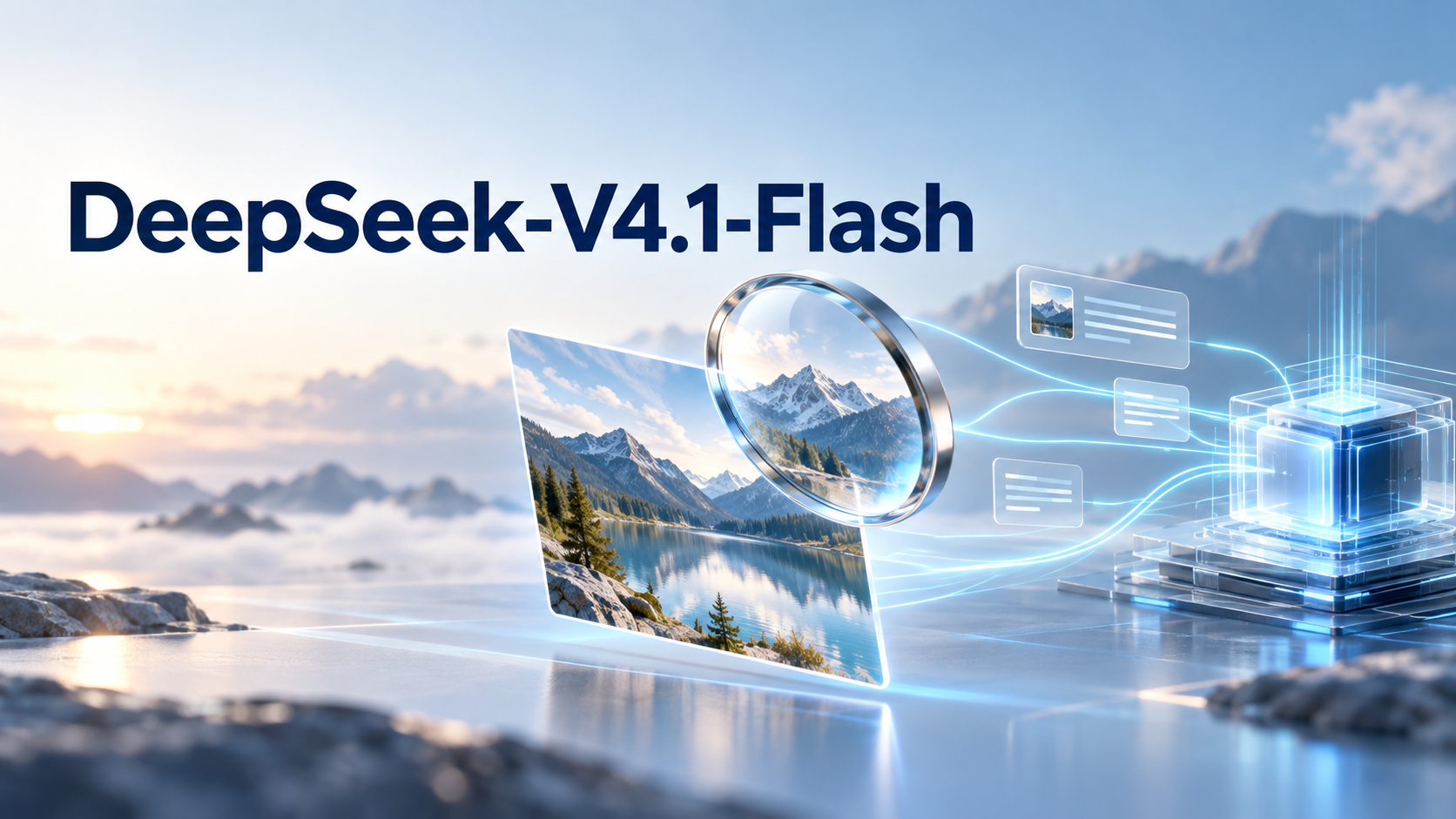
DeepSeek-V4.1-Flash Brings Images and Text into the Same Conversation. Explore How Its Visual Understanding Works, Why Its Architecture Reduces Computing Costs, and What the Latest Benchmarks and API Prices Mean for Creators Who Want Help Analyzing Visuals and Planning Their Next Edit.
A picture can show you what happened without explaining why it matters. A screenshot might contain an error message, a chart might hide a useful trend, and a product photo might need a clearer description. Understanding those details is a different task from changing the picture itself.
DeepSeek-V4.1-Flash brings image understanding into a conversational AI model. For creators, its relevance starts with a simple possibility: asking questions about a visual in ordinary language, then using the response to inform the next creative decision.
What Is DeepSeek-V4.1-Flash?
DeepSeek released the model on September 10, 2026, with native visual understanding and an architecture designed to improve capability, speed, and computing efficiency. It handles text and images together, making it a multimodal model: “multimodal” simply means it can work with more than one type of input.
The model card describes image and text inputs with text output. That distinction matters for anyone researching AI image tools. Asking it to explain a photograph produces a written response; it doesn't establish an ability to generate a new photograph or directly retouch the original.
The model card also specifies a context window of up to one million tokens. Tokens are the pieces of information a model processes. A large window gives it room for extensive material, although capacity alone doesn't guarantee that every detail will be interpreted correctly.
What Visual Understanding Means for Creators
The model can describe pictures, read text from screenshots, and analyze charts. These capabilities let users ask about the content of an image instead of first translating everything into a written description themselves.
Imagine preparing a product campaign. You could provide a photograph and ask for a factual description of the visible objects, followed by draft caption ideas. A useful instruction would separate observation from suggestion: “Describe only what is visible, then propose three captions without inventing product specifications.”
That separation keeps the task grounded. A model may recognize a bottle, label, or background, but visual recognition doesn't establish an ingredient list, certification, or performance claim.
For creators, the practical connection is between analysis and editing. An image-understanding assistant can help articulate an editing brief; the actual visual changes still require an editing tool. Judge the written advice separately from the quality of the finished image.
Why the Architecture Focuses on Efficiency
The model uses a mixture-of-experts architecture, or MoE. Think of a large organization that calls on selected specialists for each task rather than asking every employee to work on everything. The analogy describes selective computation, not human expertise or separate personalities inside the model.
DeepSeek-V4.1-Flash has 552 billion backbone parameters, the numerical values that encode its learned behavior. Its Causal Encoder–Decoder architecture activates about eight billion parameters during input processing and sixteen billion during output generation.
The architecture also reduces the memory needed for the KV cache, which stores intermediate information used during generation. DeepSeek reports roughly one-quarter of the previous generation's high-bandwidth memory requirement and one-eighth of its SSD storage requirement for this cache.
These changes help explain the emphasis on input-heavy tasks. An assistant that repeatedly reads long instructions and previous exchanges needs efficient information handling as well as capable answers. Lower infrastructure requirements, however, shouldn't be read as a guaranteed speed increase on every individual request.
DeepSeek-V4.1-Flash Benchmarks and the Latest Update
As of October 19, the current version is DeepSeek-V4.1-Flash-1017. The October 17 update also reached DeepSeek's website and app, while keeping the API model name and pricing unchanged.
Selected developer-published results for that update are:
| Benchmark | Reported Score | Test Context |
|---|---|---|
| Terminal-Bench 4.0 | 42.3 | Claude Code framework |
| DeepSWE v1.1 | 77.0 | Mini-SWE-V2 framework |
| HLE without tools | 42.6 | Full result; the text-only subset is separately reported as 44.0 |
These are different evaluations, not interchangeable measures of intelligence. Their scores shouldn't be averaged or treated as percentages of everyday tasks the model will complete successfully.
The coding results are relevant to readers building websites or automation around creative work. They don't measure photo-editing quality. Likewise, comparisons with older releases need matching frameworks and settings; a larger number alone doesn't establish a controlled improvement.
DeepSeek-V4.1-Flash API Pricing
The following direct API prices apply as checked on October 19, 2026, in US dollars per million tokens:
| Usage | Off-Peak | Peak |
|---|---|---|
| Input, cache hit | $0.003 | $0.006 |
| Input, cache miss | $0.15 | $0.30 |
| Output | $0.60 | $1.20 |
A cache hit means reusable input is charged at the lower cached rate. It doesn't mean every image or prompt automatically receives that price.
Peak hours are Monday through Friday, 01:00–04:00 and 06:00–10:00 UTC, excluding Chinese public holidays. All other hours are off-peak. One million uncached input tokens plus one million output tokens would therefore cost $0.75 off-peak or $1.50 at peak, excluding separate services.
Image inputs are also converted into billable tokens. Actual spending depends on the full exchange, including repeated requests and response length, rather than the number of uploaded pictures alone.
Where It Fits in a Creative Workflow
Developers access the latest model using deepseek-flash. The API supports thinking and non-thinking modes, tool calls, and structured JSON output, giving applications ways to request analysis and organize the response. The current model details describe these options.
For creators, a sensible evaluation starts with familiar material: a screenshot whose wording you can verify, a chart whose values you know, or a product image with an approved description. Compare the response against the source, especially small text and claims that could affect publication.
DeepSeek-V4.1-Flash is most interesting here as a way to connect visual material with language and reasoning. Its value in a creative process depends on whether that analysis produces a more accurate caption, clearer brief, or better-informed next edit. Those are useful outcomes to test separately from image generation and retouching.