What Changes with Gemini Nano Banana 2.1—and What It Costs
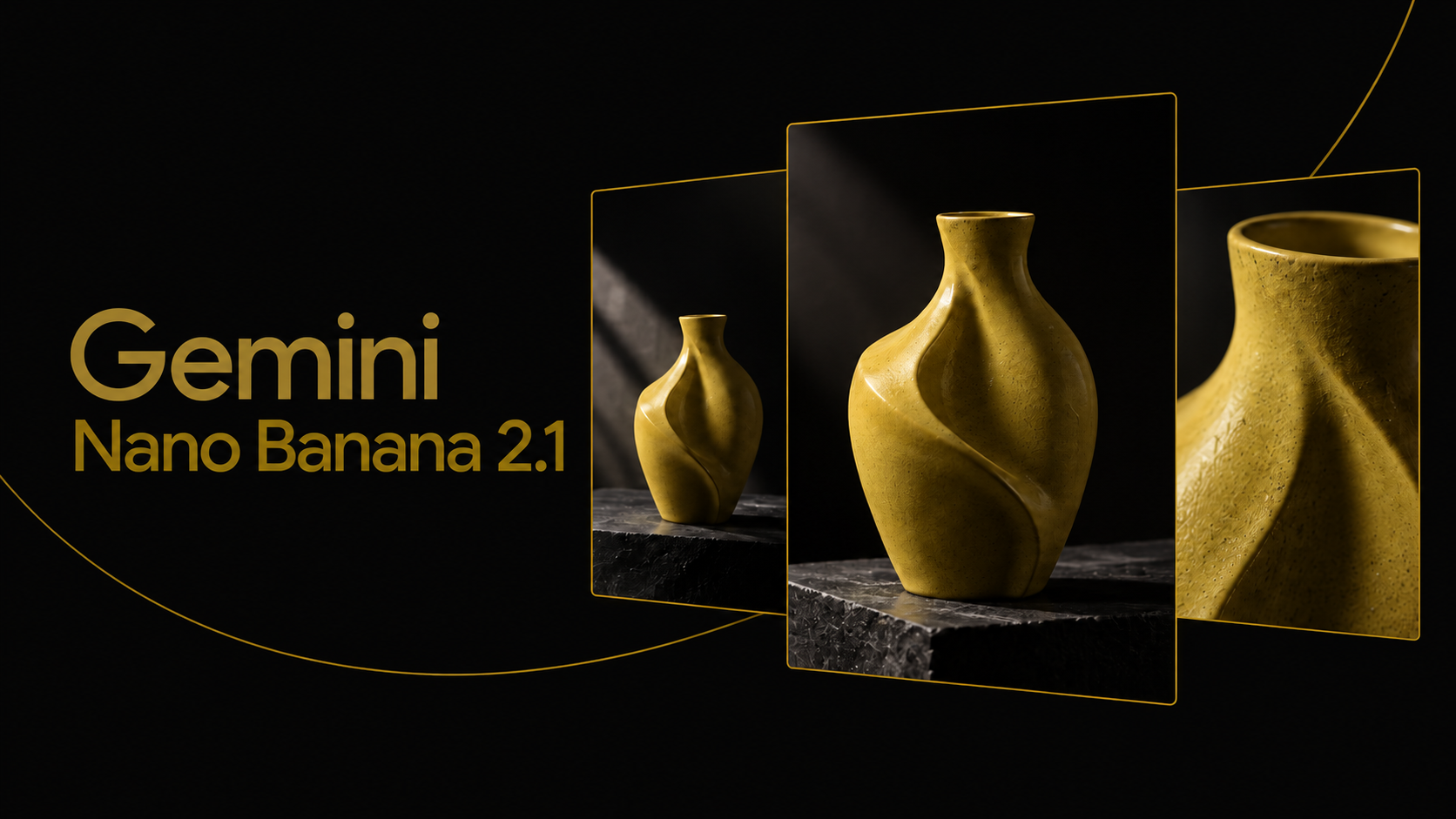
Gemini Nano Banana 2.1 updates Google’s image-generation lineup with lower image-output prices and reported quality improvements. Compare it with Nano Banana 2, understand the tradeoffs in resolution and thinking settings, and learn what to check when creating posters, product images, and edits that preserve a subject.
Gemini Nano Banana 2.1 gives teams using Google's image models a new default to evaluate. The update promises better instruction following and cleaner visual results, while its published image-output prices fall below Nano Banana 2's. That combination is appealing for campaign graphics, product scenes, and illustrated content, but it leaves two practical questions: which capabilities actually changed, and how much cheaper will a finished image be?
The answer depends on resolution, inputs, and generation settings. Several headline capabilities already existed in Nano Banana 2. Understanding that baseline makes it easier to judge the update without mistaking familiar features for new ones.
What Is Gemini Nano Banana 2.1?
Gemini Nano Banana 2.1 is Google's image-generation and conversational-editing model, available under the stable API identifier gemini-nano-banana-2.1. It succeeds Nano Banana 2, known as Gemini 3.1 Flash Image. Google Cloud records October 6, 2026, as its release date and lists it as generally available on Gemini Enterprise Agent Platform. Google Cloud documentation
You can follow the model reference's link to Google AI Studio to explore it, or use its identifier in an API integration. For an existing application, confirm which model the application actually calls. “Nano Banana” describes a family, so the name alone is insufficient when comparing outputs or estimating costs.
Nano Banana 2.1 vs. Nano Banana 2
Google describes improvements in realism, prompt adherence, text rendering, infographic layouts, and character consistency through successive edits. It also reports fixing tiling artifacts in 1:4, 4:1, 1:8, and 8:1 images at 2K and 4K. These are vendor-reported improvements; the model overview does not establish a numerical speed advantage. Official update details
The following comparison separates changed settings from capabilities carried forward.
| Capability or setting | Nano Banana 2 | Nano Banana 2.1 |
|---|---|---|
| API identifier | gemini-3.1-flash-image | gemini-nano-banana-2.1 |
| Output resolutions | 0.5K, 1K, 2K, 4K | 1K, 2K, 4K |
| Default thinking level | minimal | medium |
| Supported thinking levels | minimal, high | minimal, medium, high |
| Google Web and Image Search grounding | Supported | Supported |
Sources: Nano Banana 2 specifications and Google's image-generation guide.
4K output and search grounding therefore are not new reasons to upgrade. The meaningful change is the claimed improvement in results at supported sizes, alongside a different thinking default and the absence of 0.5K output. If your workflow uses small drafts, account for that resolution change before switching.
A fair quality comparison should use the same resolution, prompt, references, and thinking level. Comparing untouched defaults changes two variables at once. A separate test with each model's defaults can then show what users will experience without additional configuration.
Is Nano Banana 2.1 Cheaper?
Google's Gemini Developer API pricing, checked October 8, 2026, shows lower Standard image-output costs than Nano Banana 2. The saving is roughly half at 1K and 2K, but about one quarter at 4K. Official API pricing
| Resolution | Nano Banana 2 Standard | Nano Banana 2.1 Standard | Nano Banana 2.1 Batch |
|---|---|---|---|
| 1K | About $0.067 | $0.0336 | $0.0168 |
| 2K | About $0.101 | $0.0504 | $0.0252 |
| 4K | About $0.151 | About $0.113 | $0.0567 |
These are image-output charges, not complete request prices or Gemini app subscription fees. Standard input rises from $0.50 to $1.50 per million tokens; text and thinking output rise from $3 to $7.50 per million tokens. Applicable search charges also sit outside the table. The pricing page lists no free API tier for 2.1.
For example, 1,000 Standard 2K outputs cost $50.40 for image output alone. That is a useful budget baseline, but a reference-heavy request or repeated retries adds costs. Calculate the bill from a representative job, including rejected generations, before projecting a monthly saving.
For final assets, track the number of usable results as well as the number generated. A low unit price helps less when a brief needs several attempts. Conversely, an improvement in first-pass acceptance could matter more than a small difference in token charges.
Will Edits Keep the Same Face or Product?
This is one concrete reason to evaluate the update. Google lists support for up to 14 reference images, including consistency for up to four characters and fidelity for up to ten objects. It specifically identifies better multi-turn character consistency. Those capacities do not guarantee that every detail survives a modification.
For an illustrative product task, change the background around an approved pack shot, then adjust the lighting. Inspect the label, cap, silhouette, and proportions after each change. For a portrait, compare facial features separately from the new outfit or setting. An attractive scene can still fail because the subject changed.
Google's stated consistency improvements do not establish that cumulative blur or every form of image degradation has been eliminated. Treat preservation as an acceptance criterion for your own images, especially when making several small revisions.
Which Nano Banana Model Should You Use?
Google's image-generation guide recommends 2.1 for new projects. It positions Nano Banana 2 Lite around speed and cost, and Nano Banana Pro around complex visual tasks. These are starting points for selection rather than a universal quality ranking.
For a poster or infographic, begin with approved wording and inspect spelling, reading order, and relationships between labels. Google recommends preparing text before asking for an image containing it. For a panoramic banner, inspect the whole canvas for repeated scenery and joins.
Gemini Nano Banana 2.1 deserves a trial when your work combines instructions, text, and reference images. Its lower output prices strengthen the case, especially at 1K and 2K. Choose it based on how well it satisfies your actual briefs, with input charges and thinking settings included in the decision. That produces a more useful answer than assuming every new version is better at every task.