How FLUX 3 Max Brings AI Video Closer to Real Time
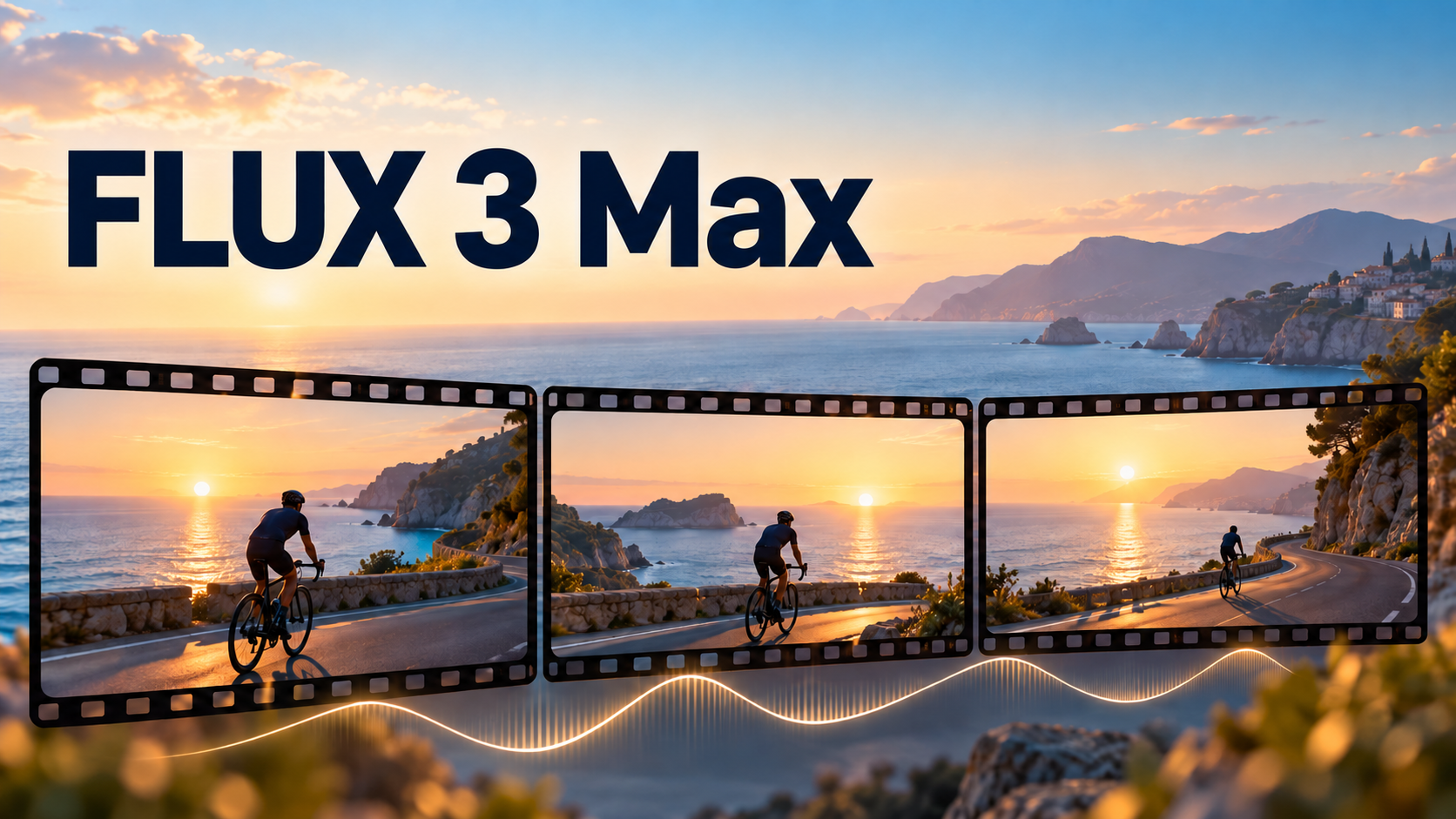
FLUX 3 Max Turns Text and Images into Short Videos with Sound. Explore How Further Training and Faster Inference Shape the Model, What Its Early Quality Scores Actually Measure, and How Duration, Resolution, and Pricing Affect the Experience of Bringing a Still Scene to Life.
A photograph freezes a moment. Turning it into video means deciding what happens next: how a person moves, where the camera travels, and what the scene sounds like. For anyone following generative AI, the interesting question is how quickly a model can make those decisions while keeping the result convincing.
FLUX 3 Max tackles that challenge with text-to-video and image-to-video generation, optional synchronized audio, and much shorter reported rendering times. Developed by fal Research in collaboration with Black Forest Labs, it builds on the FLUX 3 video model through additional training and inference optimization.
What Is FLUX 3 Max?
FLUX 3 Max is a post-trained version of FLUX 3 Video. Post-training means taking an existing model and training it further to improve particular behaviors. Here, the goals include closer adherence to prompts, stronger visual fidelity, and more coherent motion.
Think of the foundation model as supplying the broad ability to construct a moving scene. Further training refines how that ability is used. That's a useful distinction: the Max name refers to a particular adaptation of the model, rather than explaining a new architecture by itself.
The collaboration also addresses inference, the stage when a trained model processes a request and generates its output. Improving training and improving execution are different jobs. Together, they can change both how a clip looks and how long someone waits for it.
The launch announcement, published by fal on October 19, 2026, describes this as the first iteration, with further post-training continuing.
From a Written Scene to Moving Images and Sound
The simplest starting point is a text prompt. Describe the subject, action, camera movement, and atmosphere, and the model generates a short clip. Supported durations run from five to twenty seconds in one-second increments.
Image-to-video adds a visual starting point. A photograph or illustration establishes the opening composition, while the prompt describes what changes. An optional ending image guides the final frame. Imagine starting with a product photograph and asking for a slow camera move as the light shifts: the image supplies the appearance, while the words supply the movement.
For more structured direction, the keyframes endpoint accepts up to ten images at specified frame positions. These act as visual checkpoints. They guide the sequence without fixing every detail between them.
Audio can be generated alongside the picture or switched off. Dialogue and environmental sounds can be described in the prompt, so the request can express both what viewers see and what they hear.
Output defaults to 720p, with optional 1080p upscaling. Upscaling increases output resolution; it shouldn't be confused with a promise that every fine detail was generated natively at that resolution. Landscape, portrait, square, and wider cinematic framing support different destinations.
What the FLUX 3 Max Benchmarks Show
The headline quality result concerns image-to-video. In the preliminary Artificial Analysis AA-Video-I2V v1.1 snapshot reproduced on fal's product page, FLUX 3 Max scores 1,139 Elo.
Elo summarizes relative results from preference comparisons. It isn't a percentage of correct frames or a direct measure of physical accuracy. A higher score indicates stronger preference within that evaluation.
| Model | Image-to-Video Elo | Reported Time for a 10-Second Clip |
|---|---|---|
| FLUX 3 Max | 1,139 | 12.45 seconds |
| FLUX 3 | 1,089 | 126.44 seconds |
| Seedance 2.5 | 1,139 | 277.80 seconds |
These vendor-published latency figures describe average generation times for ten-second, 16:9 clips at 720p/768p. The product page describes Max as tied for first because its confidence interval overlaps the leaders. That wording doesn't mean it has the highest numerical score outright, or that a separate text-to-video test reached the same conclusion.
The launch release reports a different Max time, 10.95 seconds. Keeping the table tied to one published snapshot avoids mixing versions. Both figures suggest generation approaching the clip's playback duration under the tested conditions; neither guarantees the same wait for every request.
Why Faster Generation Changes the Creative Process
A faster render matters because video often takes several attempts. A scene can look attractive while missing the intended action, camera move, or timing. Shorter waits make it easier to identify that mismatch, change one instruction, and compare the next result.
Speed and control still need to be considered together. A starting image establishes composition, an ending frame guides the destination, and additional keyframes constrain intermediate moments. Each addresses a different kind of uncertainty.
FLUX 3 Max also offers low and high reasoning settings. Higher effort increases generation time. That tradeoff makes a single headline speed less useful than understanding the settings behind it.
FLUX 3 Max Pricing and Access
As of October 20, 2026, fal's endpoint pricing lists a 75% promotion through November 7. Text-to-video and image-to-video use the same rates.
| Resolution | Promotional Price per Output Second | Cost for 10 Seconds | Standard Price per Second |
|---|---|---|---|
| 720p | $0.0425 | $0.425 | $0.17 |
| 1080p | $0.0725 | $0.725 | $0.29 |
The ten-second examples are calculations from the listed rates. Several attempts add up: four ten-second 720p clips would cost $1.70 at the promotional rate. A low price per clip still benefits from clear prompts and deliberate revisions.
Access is available through fal's browser playground and API. The image-to-video playground accepts a starting image and an optional ending frame, making it an accessible way to explore how visual inputs affect a clip.
What FLUX 3 Max Adds to AI Video
FLUX 3 Max brings attention to an important direction in generative AI: progress can come from refining an existing model and the systems running it. Its appeal combines short videos, visual guidance, audio, and promising generation speed.
For AI enthusiasts, the useful question is how those pieces work together. A compelling clip needs more than a sharp frame: it needs the intended action, continuity over time, and sound that fits. Early benchmarks offer a reason to explore the model, while those scene-level details remain the basis for judging a particular result.